
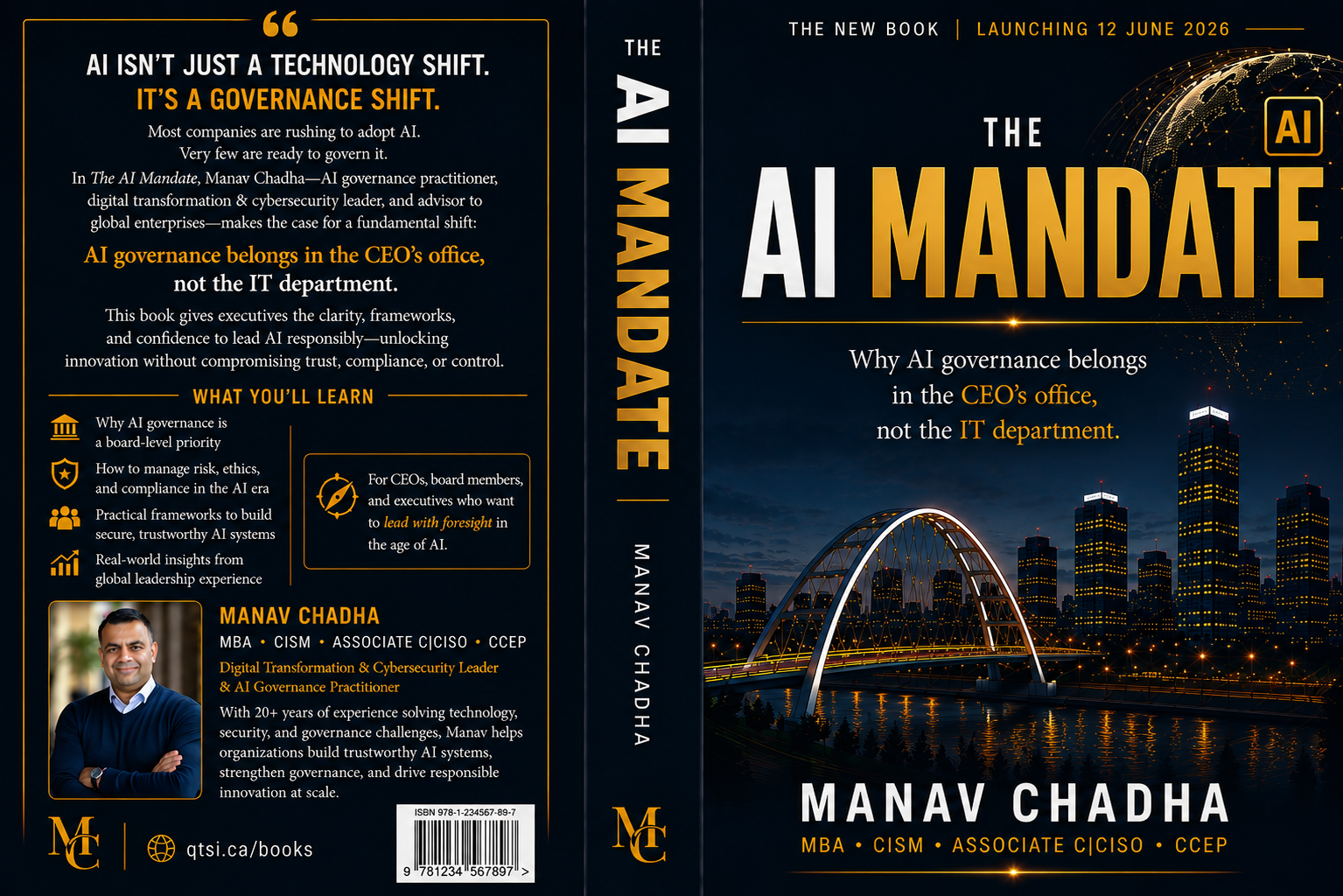
The Delegation Trap
Preface 2 min readI did not plan to write this book.
I planned to keep doing what I had been doing for over twenty years, walking into organizations, finding the gaps between what leadership believed was happening and what was actually happening, and helping close them. Quietly. Practically. Without a book attached to it.
Then I started watching the same conversation happen everywhere, in every boardroom, in every executive briefing, across every industry and every size of organization. Someone would ask about AI risk. Someone would mention data governance. Someone would raise the question of what employees were actually doing with the AI tools they had access to. And then a senior leader, always confident, always well-intentioned, would say the sentence that ends the conversation.
"The IT team handles all of that."
And that would be it. The room would move on.
I wrote this book because that sentence is the most expensive sentence in corporate leadership right now. Not because IT teams are incapable. They are often extraordinary. But because AI governance is not an IT function. It is a leadership accountability. And the gap between those two things is where organizations are getting hurt.
Why I Am the Person Writing This
I am not an academic. I am not a researcher who studied the problem from the outside. What I have is 25 years of being inside technology organizations when things went wrong. Not reading about what went wrong. Being in the room.
I have led enterprise governance programs that passed international audits. I have been inside organizations when their systems failed catastrophically. I have built a semantic leakage prevention prototype because I watched confidential data entering public AI tools every day without any governance behind it. I have coached more than two hundred professionals in IT, security, and governance.
And I have had the conversation about AI accountability with enough senior leaders to know that the problem is not knowledge. Most leaders understand, in the abstract, that AI is a risk. The problem is ownership. They have not yet decided — explicitly, visibly, in a way that changes behavior — that AI governance is their accountability.
This book is about that decision.
Why June 12th
I chose the publication date before I wrote the first word. June 12, 2026 is the one-year anniversary of losing my mother.
She was the person who taught me, through her own quiet example, that accountability is not a burden. It is a form of love. You own the outcome because you care about the people who depend on it. That is the leadership principle at the center of this book.
This book is dedicated to her. To my wife and children, who gave me the space and the love to write it. And to every leader willing to be accountable before the crisis demands it.
You can delegate the management of risk. You cannot delegate the accountability for its consequences. When something goes wrong, the board calls the CEO. Not the CTO. Not the CISO. You.
This book gives you the language, the stories, and the framework to own that accountability before the crisis — not after it.