No technology roadmap
Decisions are made reactively, project by project, with no sequencing toward a destination — so investments collide and rework piles up.
A sequenced 1–3 year planMost mid-market organizations don't need a full-time CIO — they need a CIO's judgment. QTSI gives you a seasoned technology executive on a flexible model: a clear roadmap, a defensible budget, and vendor decisions that hold up in the boardroom.

A Virtual CIO is your accountable owner for technology strategy — sitting at the leadership table, translating business goals into a sequenced plan, and making sure every dollar of IT spend ties to an outcome.
We embed alongside your executive team on a monthly cadence: setting direction, prioritizing investments, governing vendors, and reporting progress in language the board understands. You get the seniority and pattern-recognition of someone who has run this dozens of times — without the $250K+ salary, benefits, and ramp.
The symptoms are familiar: spend creeps, projects stall, and no one can answer "is our technology actually moving the business forward?" A Virtual CIO closes that gap.
Decisions are made reactively, project by project, with no sequencing toward a destination — so investments collide and rework piles up.
A sequenced 1–3 year planBudgets are guesswork, renewals auto-renew, and leadership can't tell which costs drive value versus which are pure overhead.
A defensible, outcome-tied budgetYou're steered by sales reps, not strategy — over-licensed, under-secured, and exposed when a single provider underperforms.
Independent vendor governanceEnd-to-end technology leadership — the strategic work that rarely gets done well without a dedicated executive.
A clear, sequenced plan that ties every initiative to a business outcome and a quarter to deliver it.
Right-sized budgets, renewal calendars, and spend governance that turn IT from a black box into a managed P&L line.
Executive ownership of cyber risk, business continuity, and the frameworks (NIST, SOC 2, PIPEDA) your clients ask about.
Independent evaluation, negotiation, and management of your MSP, SaaS, and infrastructure vendors.
Programme-level governance for migrations, ERP, and automation — so big initiatives ship on time and on budget.
Org-design advice, mentoring for your internal staff, and the hiring plan for when you're ready to build in-house.
A deliberate sequence — assess, plan, execute, and review on a rhythm that keeps momentum without overwhelming your team.
A rapid review of your systems, spend, risk, and goals — we map where you are and what's holding you back.
A prioritized 1–3 year plan with budgets, owners, and quick wins, presented in board-ready form.
We drive the plan with your team and vendors, governing delivery and removing blockers as they arise.
Monthly executive reporting on progress, risk, and ROI — so leadership always knows where the technology stands.
Everything you need to know before engaging a fractional technology executive.
A Virtual CIO takes ownership of your technology strategy — setting the roadmap, governing budgets, managing vendors, overseeing major projects, and reporting to your executive team and board. On a typical monthly cadence, they run strategy sessions with leadership, review vendor performance, and track initiative progress against the plan.
A managed IT provider handles operational support — helpdesk, backups, endpoints. A Virtual CIO sits at the leadership table and owns strategy, investment decisions, and outcome accountability. Many organizations use both: the vCIO directs and governs while the MSP executes.
Engagements are scoped to your organization's size and complexity on a monthly retainer — typically 20–30% of the cost of a full-time CIO hire ($250K+ in total compensation), with no benefits, equity, or ramp period.
Engagements begin with a rapid assessment in week one. A board-ready technology roadmap is typically delivered within 90 days. Quick wins — vendor consolidations, cost reductions, security posture improvements — are identified and actioned within the first 30–60 days.
No. A Virtual CIO governs and directs; your existing IT staff or MSP continues to handle day-to-day operations. The vCIO is additive — they provide the strategic layer that elevates your whole IT function without disrupting what's already working.
Technology leadership is most effective when paired with the right operational foundation. These services work hand-in-hand with a Virtual CIO engagement.
Real outcomes from organizations that put a Virtual CIO in their corner.
We'd been managing IT by committee for three years — decisions stalled, costs crept up, and no one could tell the board where we were headed. QTSI's vCIO delivered a board-ready technology roadmap in 90 days. Leadership finally had a plan it could defend.
Board-ready roadmap in 90 daysThe first deliverable was a spend audit. QTSI identified $180K in annual savings across redundant licensing and mis-negotiated contracts — it paid for the engagement many times over before we even touched the roadmap.
$180K in annual savings identified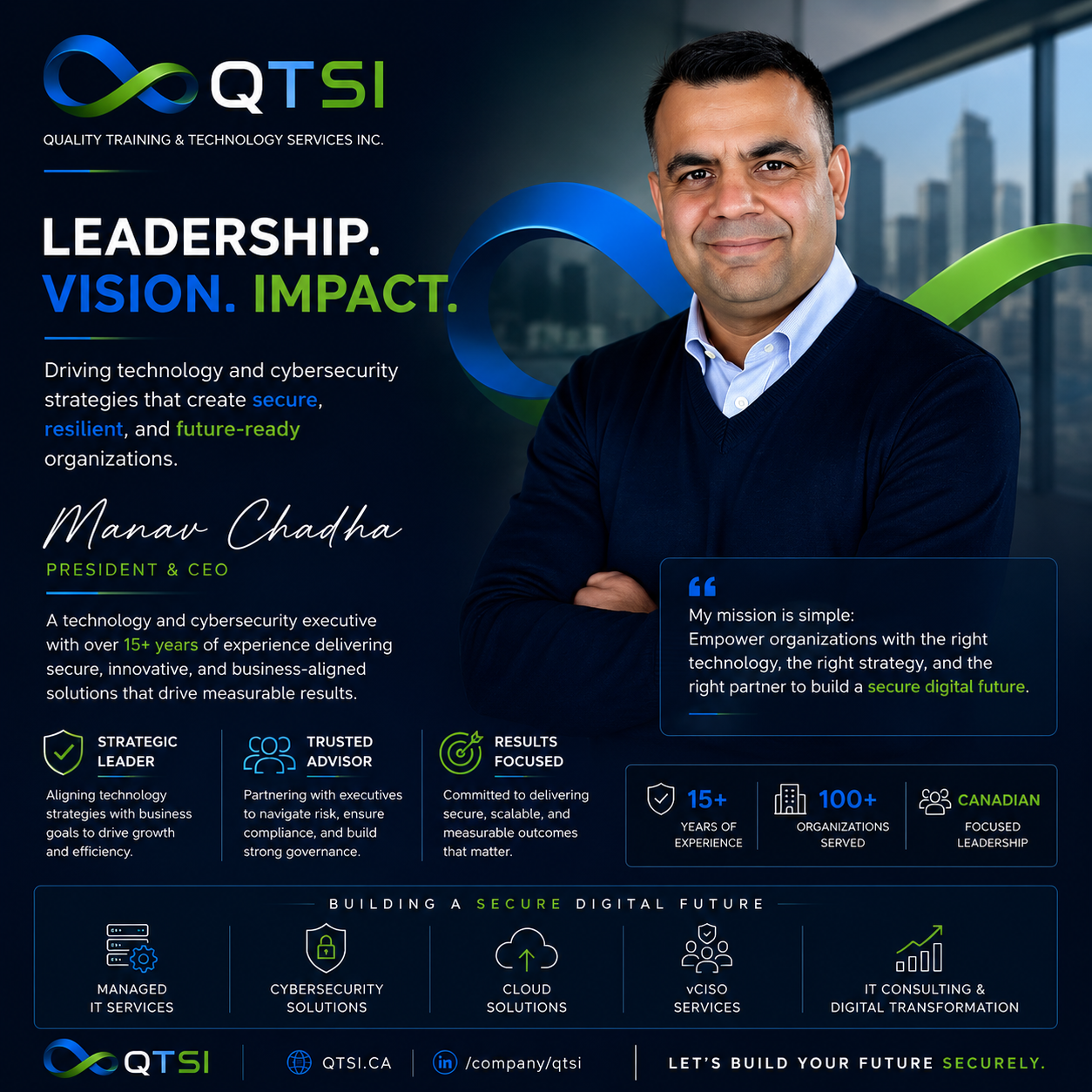
Founder & CEO · vCISO / GRC Strategist
Manav has served as a Virtual CIO for organizations across Edmonton, Alberta, and Western Canada — developing technology roadmaps, governing IT budgets, and managing vendor relationships as a fractional executive. He brings board-level credibility and a 20+ year track record of translating technology decisions into measurable business outcomes.
Book a no-obligation strategy call with Manav Chadha. We'll pressure-test where your technology stands today and outline the first three moves that matter.
Free & confidential · Manav personally reviews every request within one business day.
Prefer to talk? Call us: 780-716-5372